Rabbi's Column

Rabbi's Column with Davar Acher by Louis King, Kulanu Co-Chair - November 2026

Dear TBT Family,

This month, I am trying something new. Following my column, you will find a ‘davar acher’, which means another perspective. This is an ancient rabbinic strategy of examining a topic from multiple angles. This month’s davar acher was written by our Kulanu co-chair, Louis King.

November brings both Election Day and the solemn anniversary of Kristallnacht, the Night of Broken Glass. This sobering confluence invites us to reflect on our civic responsibility in light of what history has taken from us.

Kristallnacht is part of a larger story about democratic freedoms that vanished slowly, and then quickly. When life became difficult and grievances went unaddressed, people sought someone to blame—and Jews became the scapegoat. Today, we feel vulnerable once again. Since October 7th, we have too often seen legitimate criticism of Israel and compassion for Palestinians become entangled with something altogether different: the expression of hatred toward Jews as a people, or the holding of Jews collectively responsible for Israel's actions. We have seen this on college campuses and on social media, from across the political spectrum. Amid polarization and acerbic rhetoric, it’s easy to wonder where we fit in public life. But my message is this: we must not abandon our civic responsibility. We must not give in to cynicism.

Three years after October 7th, I feel like an October 8th Jew. That was a lonely day. Where I expected allyship, I found silence. Where I hoped for condemnation of the massacre, I encountered moral equivocation. Almost instantly, the protests began— not against Hamas, but against Israel. That experience was a wake-up call for me. If these three years have taught me anything, it is that no single political figure, party, or ideology can guarantee Jewish safety. When citizens feel their government doesn’t care, they listen to leaders who promise easy remedies—regardless of what is true; regardless of what is democratic. In such climates, political violence gradually becomes an acceptable means of dispute resolution. This is why free and fair elections matter; why voting access for all eligible citizens matters; why the peaceful transfer of power is a bedrock of American liberty. Although it is deeply imperfect, our democratic system has protected us on these shores for over 200 years. It will only continue to do so if we fight to protect it.

While sweeping national tides can feel overwhelming, we can make an immediate impact in our Shoreline communities. We can:

  • Vote, and defend the right of every eligible citizen to do the same.

  • Volunteer at the polls (I am always inspired to see my dear colleague and friend, Rabbi Hesch Sommer, volunteering at every Guilford election!).

  • Support people and organizations that protect the integrity of our democratic process.

  • Care for the most vulnerable. TBT has lived this mission for decades through our Social Justice Committee and our active partnerships with IRIS, Habitat for Humanity and the Branford Community Dining Room. Volunteer opportunities are ample, so please let me know if you’d like to get involved.

To underscore our commitment this year, Temple Beth Tikvah will participate in the global "Spread the Light" initiative. On the evening of November 9th, we will leave the lights burning in our synagogue overnight. Where Nazi pogroms once sought to defile our sanctuaries and plunge our people into darkness, our beautiful campus will stand as a quiet, defiant testament: Our spirits are bruised, but unbroken; our oath to bring light into a fractured world remains undimmed.

Shalom,
Rabbi Danny Moss

Davar Acher

The Rabbi reminds us of the power of our vote. I want to add a second thought. In March 1933, Germans went to the polls in what would be the last multiparty national election before the Nazi dictatorship consolidated its control. Democratic institutions were already under assault, and the ballot alone could no longer protect the rights of German Jews. After that, the ballot protected no one. What remained was whether ordinary people would speak up. Within weeks, the Nazis organized a boycott of Jewish businesses. In 1935, the Nuremberg Laws stripped Jews of citizenship. In July 1938, thirty-two nations met at Évian and nearly all refused to take in Jewish refugees. Each step tested whether anyone would object, and few did. By November, the glass was broken.

Today, we are living through a rise in antisemitism that has accelerated since October 7th. It is easy to feel overwhelmed, to watch and say nothing. That silence is what hate tests for.

Our answer is to stand up, together. Kulanu, “all of us,” is building allies and speaking to the broader shoreline community about the rise in hatred, so our neighbors understand what we face and stand with us.

The Blue Square is one step each of us can take. It is a visible sign that says: I stand up to Jewish hate. It starts a conversation, every day, and Kulanu will help prepare us for it. We know Rabbi Tarfon’s teaching: we are not required to finish the work, but neither are we free to abandon it. Our vote is one act we complete. This work we never finish. Take the next step. Pick up a Blue Square pin in the lobby.

Louis King, Kulanu Co-Chair
Rabbi's Column - October 2026

Dear TBT Family,

This Jubilee year, we celebrate 50 years of TBT. Throughout the year, we will be celebrating the people who founded and shaped our congregational home, and telling their stories. That has led me to think a great deal about the narratives that shape our lives. On Yom Kippur, I spoke about what it means to know our Jewish story – in both our head and in our heart. The question is at least 2,000 years old, but it feels more urgent today than ever.

The cultural critic Neil Postman teaches that our lives revolve around "big stories -- stories that are sufficiently profound and complex to offer explanations of the origins and future of a people; stories that construct ideals, prescribe rules of conduct, specify sources of authority, and, in doing all this, provide a sense of community and purpose."These are meaningful stories; “thick” stories; those we tell and retell and learn from. When you think of Jewish stories like this, what first comes to mind? For me, it’s Pesach.

The Passover Seder revolves around the telling of the Exodus. This is our people’s foundational story. Its script is called the Haggadah, which simply means, storytelling. The first law of Purim is mikra megillah — we are to read the story aloud. Stories are universally powerful, and Jews are storytellers. We are blessed —and cursed – with some uncommonly powerful ones.

Furthermore, Jewish stories convey big ideas. Ideas like:
“You shall be Holy, for I am Holy.”
“In each generation, we all must see ourselves as though we, personally, left Egypt.”
“All of Israel are guarantors for one another.”
These are big ideas because they convey the heart of the Jewish mission: for cultivating the good and the sacred; for uplifting our fellow Jews; and for mending a very broken world. That’s what Judaism is for.

If all humans are storytellers, then being Jewish is a twofold invitation. Think for a minute, what in your Jewish memory do you hold especially close to your heart? Maybe it’s a wedding or Bar Mitzvah, or a holiday with family. In some way, your story converged with the Jewish story, forming a piece of your identity. What does that mean to you? What do you want it to mean to the next generation?

Jews are good at focusing on "head knowledge", which is absolutely vital. But it is the "heart knowledge" that truly matters. Heart knowledge is feeling that the Jewish story is ours to remember, celebrate, sometimes lament, treasure, and pass down. It is the deep, grounding understanding that we are protagonists in a millennia-old narrative. When we are rooted in that story, we find the ultimate antidote to rootlessness. It becomes our vehicle to resilience and Jewish joy.

But our grand, 3,000+-year-old Jewish story is really just a tapestry woven from thousands of individual, personal stories. The story of what your ancestors sacrificed for you. The story of a moment at a Shabbat table, a summer at Jewish camp, or a lifelong friendship formed right here in our synagogue. Our congregation is stronger when we show up regularly with and for one another, and to do that, we have to know each other's stories.

As your rabbi, one of my favorite roles is learning about your story. I am deeply interested in the unique experience of each family on your Jewish journey. To that end, I am reaching out to every member of our congregation during this Jubilee year. My goal is simple: to explore the ways you can find meaningful opportunities to participate and grow here at TBT, and to hear directly from you about how our community can better serve you along the way.

About half of you should have received an invitation in the mail from me already. The remaining invitations will be forthcoming in 2027. If, however, you haven’t yet received one but you’d like to meet sooner, just let me know. I would be absolutely delighted to sit down together.

I am here to help, to listen, and to learn. I can’t wait to hear your Jewish story, and to figure out together what the next chapter holds.

Shalom,
Rabbi Danny Moss

Rabbi's Column - May 2026

Dear Friends,

The Torah teaches that two master artisans, Betzalal and Oholieb, completed the ancient Mishkan (sanctuary) with beauty and breathtaking skill. They were not liturgists, or priests, or rabbis. Rather, they worked with their hands, and their hearts. From this we learn that every member of our congregation brings different gifts to bear, regardless of our backgrounds. And we are all learners, too!

This premise led us to design Kesher, our small groups initiative at TBT. It’s open to anyone who is a member of our congregation.

Do you have a special passion, a particular expertise, or simply a topic you’d love to explore more deeply with others in our community? Consider forming a Kesher group. Kesher, which means “connection” in Hebrew, is TBT’s umbrella for small groups that bring congregants together around shared interests. Our current Keshers cover a wide range of subjects—including cooking, woodworking, spirituality, hiking, young families, and mussar (practical Jewish ethics)—and we’re eager to add more.

Recent ideas include photography, Israeli Folk Dancing, and Jewish literature. If any of those are up your alley, please let us know!

As a Kesher leader, you would:
Choose the focus of your group
Set goals and agendas
Schedule meetings at a pace that works for you and your participants

TBT will provide logistical support and periodic gatherings for Kesher leaders to share ideas, resources, and solutions to common challenges. Whether you’re an artist at heart, a craftsperson, a philosopher, or something else altogether – Kesher is for you!

If you’re interested in starting a new Kesher group, please contact the Kesher Leaders group Chairperson Michael Feldman at michael@mafeldman.com.

Shalom,
Rabbi Danny Moss
Michael Feldman

Rabbi's Column - April 2026

Dear Friends,

Did you know that the Statue of Liberty has a Jewish story? Our Confirmation Class discovered the statue’s foundations — both literal and figurative — on our recent trip to New York City.

The story begins with a great Jewish American who should be a household name: Emma Lazarus. Born to a prominent Sephardic family in the 1840s, she was already a published author by age 14. By the 1880s, hundreds of thousands of Jews were fleeing violent Russian pogroms. Bearing witness to the plight of her people, Lazarus dedicated much of her life to aiding migrants in distress. She volunteered at New York’s Ward’s Island, which at that time served as a first point of arrival for new immigrants, as well as a hospital for the ill and infirm. She was an early volunteer in the Hebrew Immigrant Aid Society, today known as HIAS.

Lazarus concretized what became her life’s vocation into a powerful poem. Calling it The New Colossus, she drew a contrast between the imposing, martial Colossus of Rhodes and the welcoming, maternal Lady Liberty. She penned the poem as part of an effort to raise funds for the statue’s completion. Rediscovered some years later, the poem became so popular that it was engraved on a plaque in the statue’s base, where it remains today. You know the famous refrain:

Not like the brazen giant of Greek fame,
With conquering limbs astride from land to land;
Here at our sea-washed, sunset gates shall stand
A mighty woman with a torch, whose flame
Is the imprisoned lightning, and her name
Mother of Exiles. From her beacon-hand
Glows world-wide welcome; her mild eyes command
The air-bridged harbor that twin cities frame.
“Keep, ancient lands, your storied pomp!” cries she
With silent lips. “Give me your tired, your poor,
Your huddled masses yearning to breathe free,
The wretched refuse of your teeming shore.
Send these, the homeless, tempest-tost to me,
I lift my lamp beside the golden door!”

Our confirmation class recited these words in New York Harbor as we traced the immigrant stories that unite us. We visited two historic synagogues, as well as the tenement museum, where families of 10 or more routinely shared 350 square feet. So many of us have ancestors who braved these conditions in search of a better life. Do you know your family’s immigration story?

As time goes on, each generation feels increasingly distant from our forebears. On one hand, this is a success: our teenagers feel the comforts of modern life as full Americans. On the other hand, oppression has shaped Jewish identity in profound ways. And even if we are determined to forget this dimension of our history, it seems the world will always stand ready to remind us. When we understand where we come from, we better understand ourselves.

The Jewish story is one of outsidership. Abraham, the very first Hebrew, famously described himself as a “stranger in a strange land.” That very word, Hebrew (“ivri”), refers to crossing between places - an identity that passes from here to there, but doesn’t always fit solely in either place.

At Pesach, we sit down with family to tell our freedom story. The Haggadah explains that its own narrative arc proceeds from g’nut l’shevach - degradation to praise. Avadim Hayinu, we cry! We were slaves, and now we are free.

We are further instructed to see ourselves, individually, as if we all came out of Egypt. The collective memory, in other words, becomes our personal responsibility.

Our confirmation students have been examining this history all year, in conversation with their family stories. I hope that they felt the weight of that history on our visit to New York. It is a history that imbues us with privilege, as well as profound responsibility. This year marks 250 years of the American experiment. What a wonderful opportunity for all of us to discover (or rediscover) our own family stories.

Each year Passover bids us remember:

We were slaves, so we must fight for the oppressed.
We know the pain of the outsider. And so, we are called, like Emma Lazarus, to aid the outsiders among us.

This year we are here, next year in the land of Israel.
This year, many are in chains. Next year, may all be free.

Chag Kasher V’Sameach (Happy Passover!),

Rabbi Moss

Rabbi's Column - March 2026

Dear Friends,

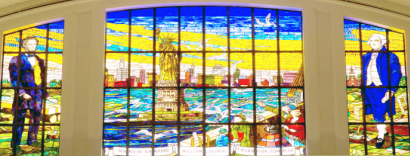
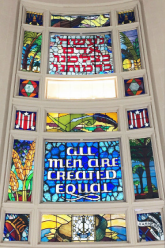
In 1941, Nazi sympathizers destroyed a window at Chicago’s Anshe Emet Synagogue. In response, Senior Rabbi Solomon Goldman commissioned what is now called the Liberty Window. The beautiful stained glass depicts immigrants peering over a ship rail as they enter New York harbor, in search of a new life.

It was a remarkable decision to include American iconography on the same plane as texts from Torah and the Prophets. But Rabbi Goldman — a notable scholar, Zionist leader, and visionary community-builder — saw it as an opportunity to double down on the congregation’s values. He believed that the American Jewish experience was as significant in the story of the Jewish people as our Biblical origins.

Rabbi Goldman’s grandson, Rabbi Danny Zemel, is an equally bold leader. He is also an important mentor to Susan and me. Many of you remember Rabbi Zemel from the special weekend he spent as our scholar-in-residence four years ago. I am delighted that he will visit us once again for Shabbat on March 20th-21st.

Rabbi Zemel has taught me so much about Judaism, synagogue excellence, and menschlichkeit. Over several decades, he shaped Temple Micah (Washington, DC) into one of our country’s visionary congregations. One of the things that inspires me about Danny is his insistence on a deeply examined, joyfully realized life as fully Jewish and fully American. Grandpa Goldman’s vision lives deeply in him. As a friend of Danny’s who shares his Chicago Jewish pride (though we do differ on baseball teams), Grandpa Goldman’s story lives in me, too. This heritage seeds an insatiable curiosity: who are we? What are we here to do? How does our past inform our future? How can we maintain our pride amid the rising tide of antisemitism? What must we build for the future? What is our Jewish story?

These are some of the questions that Rabbi Goldman confronted boldly, literally placing them front and center in Anshei Emet’s sanctuary. You see, at the same time that the vandalism was repaired, he also commissioned a beautiful skylight. It reads, “All men [sic.] are created equal, a mirror image of the accompanying text from Genesis that proclaims that all humanity was created in God’s image (Genesis 1.26). The Bible and the Declaration of Independence, side by side; two aspirational concepts held in harmony.

The promise of America is a vital chapter in the Jewish story. Over the next year, I hope we will consider that story more deeply as a congregation. I hope we may consider how the privileges and responsibilities of this precious existence ramify for us today. Rabbi Zemel will help us to begin the conversation. I hope to see you there!

Shalom,

Rabbi Moss


Rabbi's Column - February 2026

Dear Friends,

Have you ever gone swimming in February? I used to take my youth group students on a winter visit to the local pool. There’s something so satisfying about splashing around while the snow gusts and the wind howls on the other side of the window. If I’m honest, there’s probably a little schadenfreude there, too. But mostly, it’s just like a warm bath on a cold day.

Susan and I recently took our son to an indoor waterpark, and we got to experience the delight through his eyes. This one had a splash pad, a lazy river, and waterslides. It had an outdoor hot tub, too! Every so often, someone would open the door and make a break for it, enduring a few seconds of 25 degree air to get there.

Let’s just say that that part was not for me. The lazy river was more our speed. I’ve never done a polar plunge, but I can understand the appeal: the shock to the system; the burst of endorphins; truly a thrill. To each their own!

On a soul-level though, we all need both the lazy river and the polar plunge. Humans crave stability and comfort. But sometimes when we’re already there, it can be hard to get out of the lazy river! (Just try extricating yourself from one of those tiny tubes with a modicum of dignity.) The pull between stasis and change is a lot like what we do at TBT. We “comfort the afflicted and afflict the comfortable.”

This dialectic is the essence of the ancient Rabbi Tarfon’s famous teaching, lo alecha ham’lecha ligmor… “It is not upon you to complete the work, but neither are you free to desist from it,” (Mishnah Avot 2:16). Rabbi Tarfon embodies that delicate tension between comfort and agitation to action. The first half reminds us that the world’s repair doesn’t rest solely on our shoulders. It’s a message many of us need to hear in a turbulent world. Yet the second half gives a gentle jolt—an inner polar plunge—insisting that comfort cannot become an excuse for inaction. Rabbi Tarfon’s teaching holds both truths in tension, urging us to find steadiness without stagnation; discernment without disconnect.

We are confronted daily with horrors and sorrows too numerous to process, or even really to count. Nu? So? What do you need at this moment? Are you in the lazy river, or are you freezing your tuches off in an ice bath? It’s not a good idea to stay in either place for too long.

If we’re honest, the world keeps pulling us out of the lazy river whether we’re ready or not. One such moment is before us now. Leaders of the major Jewish Denominations of North America recently issued a joint letter, from which I excerpt here:

…leaders of the Reform, Conservative/Masorti, and Reconstructionist Movements of Judaism condemn, in the strongest terms, the violence with which the Department of Homeland Security is enforcing American immigration law—above all, in Minneapolis, Minnesota, as well as in cities and towns across the nation. Many Americans are deeply disturbed as they see their neighbors targeted for detention and deportation in their homes, at work, at their schools, and at their houses of worship. They are deeply concerned about numerous accounts of the use of intimidating and violent detention tactics, dangerous and unhealthy holding facilities, lack of appropriate warrants or due process, and wrongful apprehension of US citizens or individuals with proper visas based on appearance or language. [...]

Immigrants are members of our congregations, our families, and people with whom we interact in our broader communities. American Jews cherish our own families’ immigration stories. We recall that, like many being expelled from America today, we or our ancestors came to this country to escape oppression and find opportunity. That is why so many Jewish congregations, rabbis, cantors, and lay leaders have engaged in a variety of legal actions to protect immigrants in our midst. We grieve an American promise that seems to be no more.

TBT has pursued immigration justice for decades. Our tradition’s insistent demand to show kindness to immigrants- the Talmud counts 36 such mitzvot in the Hebrew Bible alone - makes our responsibility plain. If you wish to get involved, I hope you will reach out to me or to Robin Baslaw. Of the endless public matters in the public sphere, there is no doubt that immigration is a central Jewish concern.

The pain of a legal US resident, afraid to send their children to school, is our pain.

The humiliation of a US Citizen wrongly removed from his house in his underwear, at gunpoint, is our humiliation.

The terror of a five-year-old child, used as bait to lure his mother out of their house, is our terror.

The injustices are too numerous to count. There is no quick fix. But we must bear witness; we must stand up for what is right. Our people have been in this particular plunge into icy water so many times before. And, as Dr. King taught, “We are caught in an inescapable network of mutuality, tied in a single garment of destiny. Whatever affects one directly, affects all indirectly.”

I will be offering a Lunch-and-Learn on February 4th, 11th, and 18th on the Jewish roots of immigration justice. Simply contact the office to register.

Thank you for walking this path together, with care for our neighbors and for one another.

Shalom,
Rabbi Moss

Rabbi's Column - January 2026

Dear Friends,

In late December I like to reflect on the Gregorian Year gone by. 2025 was another painful year for the Jewish people — there is no denying it. But the headlines, which can be scary and demoralizing, also tend to skew our perception of the big picture. So, I am proud to present my top ten good, perhaps overlooked, Jewish News Stories of 2025.

1. A ceasefire is in place and all of our living hostages have been released. We do not know what the future holds, but this alone is reason to rejoice!

2. Palestinians protest Hamas in Gaza in a rare move. In March, Gazans organized to chant, “Shame, shame—you sold Gaza for dollars,” according to video posted on social media. “Hamas is a terrorist (group)”. “For the sake of God, Hamas Out.” “Stop the War.”

3. Gal Gadot Wins the Genesis Prize. Israeli-born actress Gal Gadot was awarded the prestigious 2025 Genesis Prize (often called the “Jewish Nobel”) for her advocacy for Israel and Jewish values during turbulent times. She pledged to donate her $1 million award to organizations supporting recovery and healing in Israel. (AP News)

4. A monumental Hellenistic‑era pyramid complex was unearthed in the Judean Desert north of Nahal Zohar, with papyri, coins, weapons and thousands of artifacts that illuminate life in the region ~2,200 years ago. Read more about this one in Archaeology Magazine.

5. And related Chanukah-adjacent news, Archaeologists completed excavation of a long, intact section of a Hasmonean‑era city wall in Jerusalem — a find tied to the Hanukkah era that offers new material links to the Maccabean period. Read more at Fox News.

6. Across the pond, two major UK Jewish movements — Liberal Judaism and Reform Judaism — voted to merge into a single Progressive Judaism movement, marking historic unity and expanded collaborative vision. (The Guardian)

7. World’s First Human Spinal Cord Transplant Scheduled. In a historic medical milestone, researchers at Tel Aviv University and the biotech firm Matricelf announced the scheduling of the world's first human spinal cord transplant. The procedure uses a patient's own engineered cells to repair damaged tissue, offering unprecedented hope for reversing paralysis.

8. Locally, the Connecticut House of Representatives passed legislation by an overwhelming vote of 128-30 to create a government working group to address Antisemitism in K–12 public schools. Seven of our State’s Jewish Federations have taken the lead on the bill.

9. Red Sox Star Projected to Sign Massive 5-Year, $155M Deal after Huge Year. After securing Alex Bregman with a record $200M+ 3-y ear contract after free agency, the Red Sox are likely to go big or go home on their All-Star third baseman, who sported a Jewish star on his cap after October 7th.

10. Mossad kills bad guys with toilet paper.* I am not making this one up, although I have my suspicions as to its credulity. I have therefore included it with an asterisk. Israeli intelligence has claimed that dozens of Hamas and Hezbollah agents have died after allegedly coming into contact with toxin-treated toilet paper. Even if it’s not true, the real story of exploding pagers is unbelievable enough.

As we close out the year, none of these stories erase the grief, fear, or uncertainty that have shaped Jewish life in 2025. But they do remind us that even in a difficult season, there is resilience, creativity, courage, and unexpected light. Progress happens quietly. Headlines often gloss over hope. And our community — across continents, denominations, and generations — continues to build, to heal, and to insist on a future worth believing in.

May the coming year bring more stories like these!

Shalom,
Rabbi Moss

Rabbi's Column - December 2025

Dear Friends,

If you look for the word “Chanukah” in the TaNaKh (Bible), you will be looking for a very long time! That’s because the historical events of Chanukah occurred after the TaNaKh was completed. Everything we know about the holiday therefore comes from post-biblical sources: the apocryphal books of Maccabees and the ancient Jewish-Roman historian Josephus are among the earliest. These sources describe the political repressions of a foreign Hellenistic regime and the internal political tensions of a Jewish community divided on how to —or even if to — fight back.

Generations after the Maccabees declared victory, the emerging rabbinic class had to make sense of this minor holiday it had inherited. The Talmud retells the military story with a subtly different framing:
On the twenty-fifth of Kislev, the days of Hanukkah are eight. One may not eulogize or fast. Why? When the Greeks entered the Sanctuary they defiled all the oils there. And when the [Maccabees] overcame them and emerged victorious over them, they searched and found only one cruse of oil that was placed with the seal of the High Priest, undisturbed by the Greeks. And there was sufficient oil there to light the menorah for only one day. A miracle occurred and they lit the menorah from it for eight days. The next year the Sages instituted those days and made them holidays with recitation of Hallel and special thanksgiving in prayer and blessings. (Tractate Shabbat 21b)

According to the Talmud, this miracle explains why we light candles for eight nights.

The Talmud describes another principle:
It is a mitzvah to place the Hanukkah lamp at the entrance to one’s house on the outside, so that all can see it. If one lives upstairs, one places it at the window adjacent to the public domain.

One of the most beautiful times to be in Jerusalem’s old city is during the last few nights of Chanukah, when rows upon rows of oil lamps glimmer outside each home. The light warms the ancient limestone in the most beautiful way. This precept is called pirsum ha’nes — publicizing the miracle. Unlike most other Jewish holidays, which take place in the synagogue or around the family table, Chanukah is supposed to be visible to the outside world. The miracle is meant to be shared.

What is it like to share Judaism in our day? I think most of us would say, it’s complicated! Many of our founding families have described to me that, in the 1970s, the goal was quite the opposite of publicity.

That was reflected in the architecture of the original building: cloistered, inward-focused.

Our beautifully renovated building sends a different message. The expansive glass and inviting design speak to me of Jewish pride. More importantly, this is reflected by the culture of hospitality we strive to cultivate. I simply love this about our congregation, and I hope you do too. In a time of rising bigotry and political strife, I am doubly grateful that these are our values.

To that effect, we will be placing a Chanukah menorah outside of our building this year. Please save the date for Wednesday, December 17th, when we will join together with the broader Jewish community to light the menorah. Our usual bring-your-own menorah and brisket cookoff will take place on Friday, December 19th.

Each Chanukah, We sing the ancient words, " הַ נֵּר וֹת הַ לָּל וּ, אֲ נַ חְ נ וּ מַ דְ לִ י קִ ין עַל הַ נִּ סִּ ים וְ עַל הַ נִּ פְ לָא וֹת וְ עַל הַ תְּ שׁ וּע וֹת וְ עַל הַ מִּ לְ חָ מ וֹת "(HaNeirot HaLalu, anachnu madlikin al haNisim v'al haNiflaot v'al haT'shu'ot v'al haMilchamot). We light these lights for the miracles, for the wonders, for the salvations, and for the struggles—past and present. The miracle is not just that the oil lasted, but that the Jewish spirit persevered. Every flame we kindle is an act of courage.

Even the smallest light has the power to define the entire space around it. As you share your light, remember that you are not just illuminating your own home; you are taking part in a collective, ancient endeavor to push back the shadows and affirm hope. We stand together, multiplying the light until the darkest night shines out like the dawn.

Shalom,
Rabbi Moss